


Adelaide City’s history on the national stage

The year 2026 was always going to be a celebration for Adelaide City.
A celebration of 80 years of a proud community, of generations nurtured through culture and football.
The success of Vas Parhas and his side has added another dimension to those celebrations, with Adelaide City’s return to the national stage providing a fitting new chapter in the club’s history.

The club’s history is punctuated by its exploits on the national level.
The 2026 NPL SA Premiership-winning season means Adelaide City returns to that stage through the Australian Championship in its 80th year.
This is Adelaide City’s first foray on the national stage since its 2022 Australia Cup run, but more importantly, its first participation in a national league-style competition since the 2002/03 NSL season.
Entering the NSL and claiming the national crown
Adelaide City originally joined the national stage as a founding club of Australia’s first national football competition, the National Soccer League (NSL). Known as Adelaide Juventus before the NSL's 1977 launch, the Black and Whites dominated the South Australian scene, claiming 12 state Championships and 13 Federation Cups from 1953 to 1976.
The club built its reputation as both a competitor on the national stage and a developer of high-end talent, even claiming the NSL Cup in 1979 under Rale Rasic. The NSL Cup glory showed City what was possible on that level, before it claimed its first national league title seven years later.
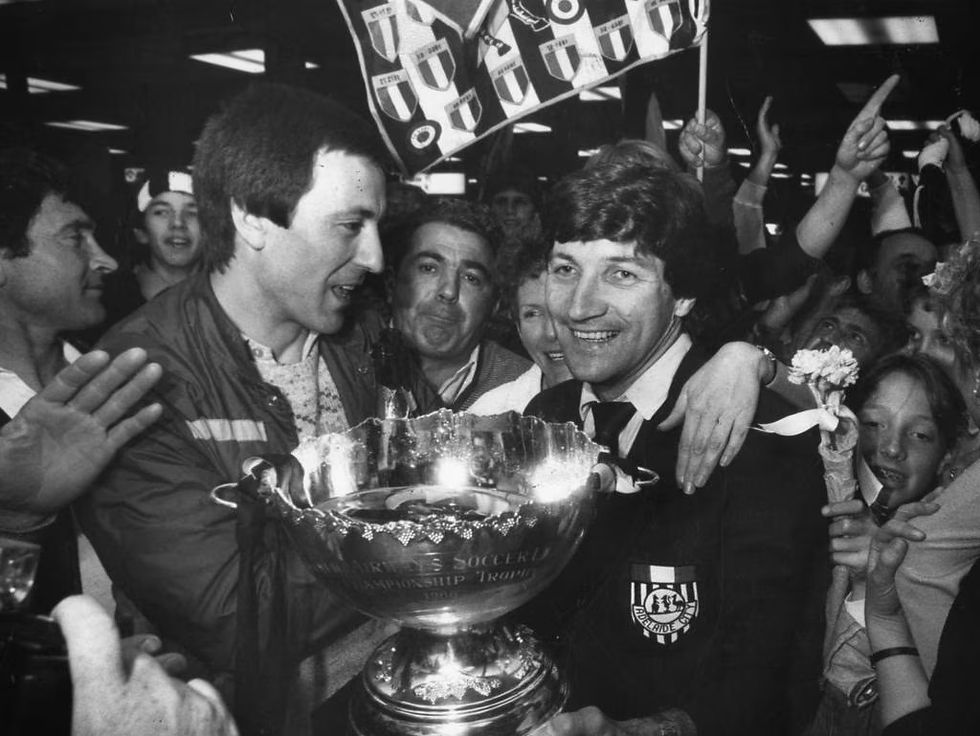
In 1986, after advancing to the NSL Grand Final from the Southern Conference, Adelaide City lost the first leg in Adelaide by a single-goal defeat to Sydney Olympic, before a statement 3-1 win in New South Wales to claim its much-celebrated first national title.
Led by coach Zoran Matic and senior players like Bugsy Nyskohus and Sergio Melta, the 1986 Adelaide City side was highlighted by an array of young players who went on to leave their mark on Adelaide City and football in South Australia and beyond for years to come, such as Aurelio Vidmar (19), Alex Tobin (20), Steve Maxwell (21), and Joe Mullen (22).
The Golden 90s
The 1986 success thrust Adelaide City into the spotlight as a nationally recognised elite club and allowed it to plan and aggressively pursue future success.
Zoran Matic was backed for his success, winning the 1987 Oceania Club Championship after qualifying as NSL Champions and went on to coach 270 games before his departure in 1995. The leadership and stability he provided became fundamental to future success.
The club continued to balance signing experienced players and developing the next generation of South Australian footballers.
Some of the core of City’s 1986 success, Alex Tobin, Sergio Melta, Paul Shillabeer, Steve Maxwell, and Joe Mullen committed to the club for the long term and played important roles in the golden decade ahead.

Along with those stabilising moves, the Black and White made important signings such as the ever-reliable Robert Zabica in goals, who played 170 consecutive games between 1988 and 1993, the prolific Carl Veart, and the legendary Milan Ivanović whose partnership in defence with Alex Tobin was so formidable, it was replicated at a national team level.
While strengthening the squad, Adelaide City won a second NSL Cup in 1989. Damian Mori's addition in 1992 made the Black and White squad almost unstoppable. With the talismanic striker, Adelaide City claimed not only the 1992 NSL Cup but also reached four consecutive NSL Grand Finals, winning the national title in 1992 and 1994 and solidifying the club as a dynasty in Australian football history.
Adelaide City’s consistent excellence is signified in the history books as the only NSL club to make 11 consecutive finals series appearances, a feat achieved between the 1990 and 2001 seasons.
The Australian Cup
The NSL’s financial and structural problems, and the launch of the A-League in 2005, meant clubs like Adelaide City, which returned to their local state competitions, had no roadmap back to the national stage until the introduction of the FFA Cup (later renamed Australia Cup).
The new national competition allowed local clubs to reclaim the spotlight they once basked in.
To qualify for the first edition of the competition in 2014, Adelaide City fittingly faced off against NSL rivals West Adelaide in the Federation Cup Final, overcoming them 4-1 to return to the national stage for the first time in over a decade.
The draw was not kind to Adelaide City, pitting it up against A-League Grand Finalists, and later ACL Champions, Western Sydney Wanderers.

Despite the battle between a fully resourced Western Sydney Wanderers side and a now semi-professional Adelaide City seeming one-sided on paper, the match delivered in the spirit of this new competition, with the Black and White reminding Australia of just what it is capable of, eliminating their fancied visitors 1-0 in front of more than 2500 people at Marden courtesy of a stunning solo Thomas Love goal.
This result is seen as the first “Cupset,” a result that allowed the football community to believe in local clubs' ability to compete against heavyweight opponents and proudly showcase their communities on the national stage once again.
Coached by NSL legend Damian Mori, Adelaide City reached the Quarter-Finals of the competition in 2014, only eliminated in extra time of that game by Bentleigh Greens.
Adelaide City reached the Round of 32 twice more, narrowly losing to Melbourne Victory at Marden in 2021, before a memorable encounter against Adelaide United in 2022 saw Paul Pezos’ men fall in a penalty shootout, despite threatening another “Cupset.”
The Australian Championship
The chapter that is about to be written.
Introduced in 2025, Adelaide City qualified for the second edition of the competition in 2026 as NPL SA Premiers. In a similar spirit to the NSL, the competition once again lets ambitious local clubs reach for the national spotlight.

Vas Parhas and his side will face Avondale City, Wests APIA, and Broadmeadow Magic in the competition's group stage.
A new page of the club’s proud history on the national stage is about to be written.
Join us at Adelaide City Park and be part of our journey!


